
“A virtual repository of the bygone era, each folio representing the subject with historical accuracy, woven with European naturalism and Indian stylization.”
The early 18th century remains consequential to Indian history as it embarks on yet another wave of change in the Indian art and the history of India at large. This new change happened due to the settlement of The East India Company which, started as a monopolistic trading body, but soon became involved in politics and acted as an agent of British Imperialism in India from early 18th century till the mid-19th century. This time frame of British rule is popularly known as colonial rule but has recently been renamed as Brutish rule.

The settlement of the The East India Company initiated profound changes, especially in art and architecture in colonial India, which led to a radical shift in artistic taste, and as a consequence a new genre of art and painting emerged, called the Company school of painting (kampani kalam in Hindi). As the Company further expanded its length and breadth in India, from Calcutta, to Delhi to Madras, the settlers witnessed exoticness of the country which, they wanted to share with their people back home. But at that time, they had at their disposal only those Indian artists who had been trained in Indian miniature art and had some knowledge of perspective, which they had acquired from the early European influence in the court art. That was not enough.
“Europeans were interested in capturing the “picturesque” and “exotic” aspect of the land, imbued with romanticism.”
Indian artists under Imperialism
Traditionally, the Indian arts had always survived on the patronage of the previous rulers, but with the British settlement that patronage (court patronage) lost power and economic potency, resulting in an impoverished state of the Indian artists. The new settlers traveled through the country and encountered unfamiliar life (flora and fauna, stunning ancient monuments, and exotic new people), which they wanted to capture in images for keepsakes and souvenirs. Hence, the Indian artists found new patronage and demand for their art. However, the English found the indigenous style and the courtly style and aesthetics not at par with their finite European aesthetics. This led to the birth of a hybrid style of art, which was truly an amalgamation of the Indian and European aesthetics to create this distinct style of painting. It was meant to capture the “picturesque and the exotic” aspect of the land, and to record the diversity of the Indian life.
The Company style
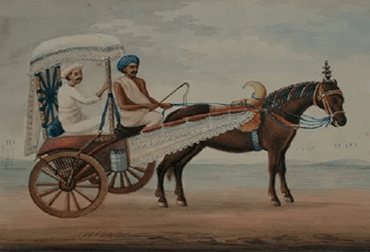
The company style had evolved as a way of providing paintings that would document the uncharted land, in a style that would appeal to the new European patrons. Although predominantly, the style displays the finest weave of naturalistic representation and the stylization of Indian miniatures, yet as we study the paintings from various regions, especially from the most popular schools namely, Patna, Mushidabad, Delhi, and Madras, we encounter the regional touch in the style. For example, in Tamtam (Horse Drawn Carriage), by Shiv Lal, Patna School, a distinguishing characteristic of Patna school is a lack of landscape and a presence of flimsy surroundings. In Murshidabad, artists developed the technique of using colour wash to achieve the British desired picturesque effect. It is this intermingling of the right aesthetics and the regional artistic influence that makes this distinct style of painting so popular.
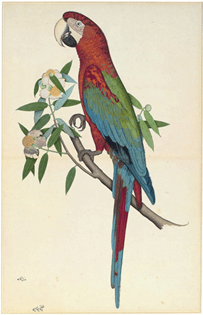
These paintings were generally rendered on paper and mica in watercolours. The chosen canvas was filled with the favourite subjects of the patrons; scenes of Indian daily life, flora and fauna (after studying the collections, it seems natural studies was the popular theme), local rulers, festivals and ceremonies, albums illustrating the various castes and occupations, the opulent Mughal courts and architecture in line with the concept of the picturesque. Though the most favoured canvas was paper, most Mughal rulers also got the painting done on small ivory plaques, especially portraits.
A detailed rendering of the subject, with linear perspective, and usage of light and shade to create romanticized views of landscape and architecture, achieved by soft textures and tones in watercolour.

A virtual repository of the past
Such paintings are factual archives and serve as a representation of life in India, especially that of ordinary people. Today, these documentary folios are a useful resource for historians and artists alike to study the past and distant past. Regrettably, such a style did not flourish in every part of the country as there were not enough monuments and ancient ruins to attract attention. Furthermore, the introduction of photography in 1840s and the fall of The East India Company resulted in the extinction of the company school.

 The Art Spectre
Leave a comment