
Painted photographs, an art genre from the nineteenth century, are a product of the artistic collaboration between photographers and traditional Indian artists, especially portraitists. As the name suggests, it literally means painting a finished photograph by manually adding layers of colors to an otherwise monochromatic photograph.
To make photographs as realistic as possible, Swiss painter and print-maker Johann Baptist Isenring invented the technique by using a mix of gum Arabic and certain pigments to color the monochromatic photograph. To achieve a desired artistic result, colors – watercolors, paints, and dyes were applied via painter’s tools.
In India, shortly after its introduction, the art of photography gained massive popularity among royalty, wealthy art patrons, and the masses. It re-established portraiture as the most desired art genre and now even the common people could afford to have their impressions captured, which was a luxury available to only some wealthiest patrons through traditional mediums (e.g., oil painting) of portrait -making. Despite technological developments, the medium of photography was monochromatic, and with the background of the rich Indian painting traditions imbued in vivid colors, the demand for coloring the photographs was obvious and high. This resulted in a new aesthetic that integrated aspects of painting and photography into one image, and paint became a new tool for enhancing images by heightening their realism, or just for artistic purposes. The demand was such that professionals were hired and ‘kaarkhanas’ or studios were set up by the photographers to cater to this new artistry.
With the establishment of the British Empire, the court painters lost their patrons and were struggling to get work. Initially, they were roped in to create works for the Empire to capture the land and its attributes in all its glory with a hint of English romanticism and use of perspective, called Company painting, which soon declined due to the advent of photography, which resulted in miniature painters losing work. They mostly acquired work as colorists in such Kaarkhanas, to earn and survive through their art. The aesthetic impact of this artistry was not only appreciated by the wealthiest patrons but also by the masses as it allowed them to fulfill their fantasy and their aspiration to achieve the opulent lifestyle of the wealthy royals. Their desire for opulence led to the studios being equipped with bespoke luxurious background settings similar to those of the royals: either the backgrounds were painted with props similar to those used by the royals, or pictures were painted on them. The new middle-class patrons wanted to be bejeweled with gems and draped in the fanciest of clothes, to visually fulfill their extravagant fantasy, as can be seen through the photographs of the time.
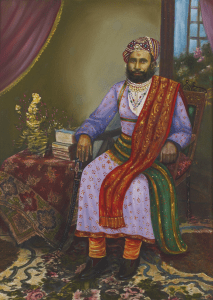
There were two methods of adding color to a photograph. The first method was tinting the glass-plate negatives which gave the photograph a subdued look. In the second method, the artist would cover the photograph with an opaque layer of desired paint. Interestingly, the painted photographs present a most riveting interpretation of the history of the genre by observing that it was not just the traditional artists who were coloring the new canvas but also the photographers who were layering the photographs as per the artistic demand. Today, however, this artistry has ceased to exist commercially, but it is practiced by a few individual artists for art’s sake. Such artistries especially of the nineteenth century as it brought in completely foreign and non-traditional artistic stimulus, are proof of the remarkability of Indian artists, who were facing these drastic challenges of new arts and synthesizing them into unique genres.

 The Art Spectre
Leave a comment